Dear Reader,
“These two books are extremely helpful
for learning practical ways…[to enhance your leadership effectiveness]. The
exercises taught in these books are the single most effective way to begin
changing a pattern [of ineffective behaviour]”…. read
manual for The Leadership Circle Profile (LCP). We use LCP for profiling and
leadership development of senior executives. This book was recommended at 5
places in the manual!!
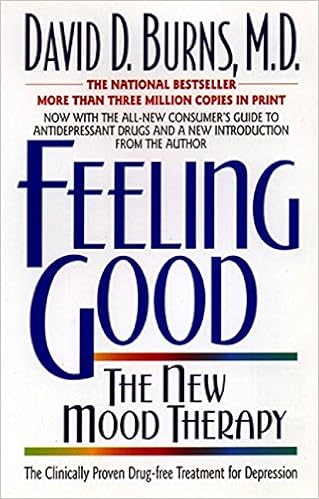
I bought the book. The cover said: “Feeling Good, the new
mood therapy: The Clinically Proven Drug Free treatment related to Depression” by
David D Burns, MD
 My first reaction was: “How is leadership
development related to depression? Why did I waste my money???”
I read along and found a treasure trove.
Don’t let the cover fool you into avoiding this book thinking that it is meant only
for clinically depressed people. It is one of the essential reads for any human
being in my opinion.
I found the book very powerful. It has
simple, scientifically proven techniques. It helps in enhancing one’s outlook
to life in any situation:
-
Recognize causes of mood swings
-
Nip negative feelings in the
bud
-
Deal with guilt
-
Handle hostility and criticism
-
Overcome addiction to love and
approval
-
Beat do-nothing-ism
-
Build self esteem
-
Understand and handle any level
of anger
The exercises, rationale, role play,
various self-assessment questionnaires, sample stories are simple, practical,
easy to use.
Dr Burns explains how our moods and actions
are a result of our own thoughts and perceptions.
I particularly like the chapter on
cognitive distortions that result into negative thoughts. Especially on
- Labeling: Your self cannot be equated with any one thing you
do. Your life is a complex and ever-changing flow of thoughts, emotions, and
actions. To put it another way, you are more like a river than a statue.
-
Personalization: Personalization causes you to feel crippling guilt. You suffer from
a paralyzing and burdensome sense of responsibility that forces you to carry
the whole world on your shoulders. You have confused influence with control
over others.
An excerpt is given at the end of this
mail.
I found ways to resolve some long pending
behaviours and assumptions of mine: being a perfectionist, avoiding criticism
and confrontation, approval addiction, linking self worth to achievements etc.
May this book help you and your near and
dear ones to develop a sustained positive outlook on life and experience the
joy of ‘feeling good’.
(PS: in case you are wondering, the other
book recommended by TLC is The
Feeling Good Handbook: The Groundbreaking Program with Powerful New Techniques
and Step-by-Step Exercises to Overcome Depression, Conquer Anxiety, and Enjoy
Greater Intimacy. Next on my reading list !)
Warm
regards,
Rohan
Excerpts
from Feeling Good by David D Burns, MD:
Labeling and
Mislabeling. Personal labeling means creating a
completely negative self-image based on your errors. It is an extreme form of
overgeneralization. The philosophy behind it is "The measure of a man is
the mistakes he makes." There is a good chance you are involved in a
personal labeling whenever you describe your mistakes with sentences beginning
with "I'm a..." For example, when you miss your putt on the
eighteenth hole, you might say, "I'm a born loser" instead of "I
goofed up on my putt." Similarly, when the stock you invested in goes down
instead of up, you might think, "I'm a failure" instead of "I
made a mistake."
Labeling yourself is
not only self-defeating, it is irrational. Your self cannot be equated
with any one thing you do. Your life is a complex and ever-changing flow
of thoughts, emotions, and actions. To put it another way, you are more like
a river than a statue. Stop trying to define yourself with negative
labels—they are overly simplistic and wrong. Would you think of yourself
exclusively as an "eater" just because you eat, or a
"breather" just because you breathe? This is nonsense, but such
nonsense becomes painful when you label yourself out of a sense of your own
inadequacies.
When you label other
people, you will invariably generate hostility. A common example is the boss
who sees his occasionally irritable secretary as "an uncooperative
bitch." Because of this label, he resents her and jumps at every chance to
criticize her. She, in turn, labels him an "insensitive chauvinist"
and complains about him at every opportunity. So, around and around they go at
each other's throats, focusing on every weakness or imperfection as proof of
the other's worthlessness.
Mislabeling involves
describing an event with words that are inaccurate and emotionally heavily
loaded. For example, a woman on a diet ate a dish of ice cream and thought,
"How disgusting and repulsive of me. I'm a pig." These thoughts made
her so upset she ate the whole quart of ice cream!
Personalization. This distortion is the mother of guilt! You assume responsibility
for a negative even when there is no basis for doing so. You arbitrarily
conclude that what happened was your fault or reflects your inadequacy, even
when you were not responsible for it. For example, when a patient didn't do a
self-help assignment I had suggested, I felt guilty because of my thought,
"I must be a lousy therapist. It's my fault that she isn't working harder
to help herself. It's my responsibility to make sure she gets well." When
a mother saw her child's report card, there was a note from the teacher
indicating the child was not working well. She immediately decided, "I
must be a bad mother. This shows how I've failed."
Personalization
causes you to feel crippling guilt. You suffer from a paralyzing and burdensome
sense of responsibility that forces you to carry the whole world on your
shoulders. You have confused influence with control
over others. In your role as a teacher, counselor, parent, physician,
salesman, executive, you will certainly influence the people you interact with,
but no one could reasonably expect you to control them. What the other person
does is ultimately his or her responsibility, not yours.


